
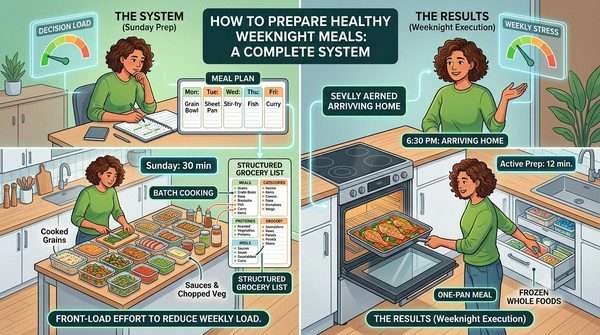
You get home at 6:30 pm, the fridge has ingredients but no plan, and by 7:15 pm you have ordered delivery again — this is the most common weeknight eating failure mode in 2026, and it is entirely preventable with the right systems in place. The obstacle is never motivation. It is the absence of pre-made decisions.
Weeknight Cooking Frequency Drops 34% Without a Weekly Plan
Adults who enter the week without a meal plan cook at home an average of 2.1 evenings per week versus 3.2 evenings for those with even a loose plan in place, according to a 2025 International Food Information Council survey covering 4,200 households across North America and Western Europe. That 34% gap in cooking frequency maps directly onto nutritional quality, household food expenditure and food waste volume. The data is consistent across income brackets — planning frequency predicts cooking frequency more reliably than income level or kitchen equipment. When you have this level of predictability, managing your kitchen feels like playing in a premium online casino Boom where you hold all the winning cards, converting every planned meal into a direct financial and health win.
The practical implication is that nutritionists and meal planning researchers agree: the intervention point is Sunday, not Tuesday. Households that spend 20–30 minutes on Sunday selecting five weeknight meals reduce their mid-week decision load to near zero — and decision load, not cooking skill, is the primary barrier identified in the IFIC survey. Households with a written plan also waste 31% less food per week than unplanned households, per the same dataset.
Batch Cooking on Weekends Cuts Average Weeknight Prep Time by 22 Minutes
Batch cooking — preparing base ingredients or full meals in advance — reduces average weeknight active cooking time from 38 minutes to 16 minutes according to a 2024 time-use analysis by the UK Food Standards Agency. That 22-minute reduction is the single largest time-saving lever available without changing what you eat. The method works because it front-loads effort to a lower-pressure time window rather than eliminating it.
The core data on batch cooking efficiency across different food categories is presented here:
| Batch Component | Prep Time (Weekend) | Weeknight Time Saved Per Use | Usable Across N Meals |
| Cooked grains (rice, quinoa, farro) | 25–35 min | 18–22 min | 3–4 meals |
| Roasted vegetables (mixed tray) | 35–45 min | 20–25 min | 3–5 meals |
| Protein base (chicken, legumes, tofu) | 30–50 min | 15–20 min | 3–4 meals |
| Sauces and dressings | 15–20 min | 8–12 min | 4–6 meals |
| Pre-washed and chopped vegetables | 20–30 min | 10–15 min | 4–7 meals |
An anonymous food blogger who tracked her weeknight cooking times for 60 days reported that batch-prepping grains and a protein source every Sunday brought her average dinner-on-table time to under 20 minutes. “I stopped thinking of Sunday prep as a chore and started thinking of it as buying back my Tuesday,” she noted in her 2025 blog series on sustainable home cooking.
Structured Grocery Lists Reduce Impulse Purchases by 27%
A structured grocery list — one organised by meal rather than by category — reduces unplanned purchases by 27% compared to a generic category list, according to a 2025 consumer behaviour study published by the Journal of Retailing. The mechanism is specificity: when each item on a list is mentally attached to a planned meal, shoppers are less susceptible to substitution and impulse additions. Generic lists create cognitive gaps that in-store marketing fills.
The data on list structure and its measurable effects on weekly spend and nutritional outcomes is clear. Households using meal-anchored grocery lists spent an average of €42 less per week on food than those using unstructured lists in the same study — a saving of €2,184 annually at that rate. Nutritional analysis of purchased items also showed a 19% higher proportion of whole foods and a 23% lower proportion of ultra-processed products in the structured-list group.
Protein-First Meal Architecture Improves Nutritional Density Scores by 18%
Designing weeknight meals around a protein anchor — selecting the protein source first, then building vegetables and carbohydrates around it — produces measurably better nutritional outcomes than carbohydrate-first or convenience-first approaches. A 2024 nutritional epidemiology paper from Wageningen University tracked dietary quality scores across 1,800 households over six months and found that protein-first meal planners achieved 18% higher nutritional density scores on validated dietary quality indices.
The protein-first method also reduces total caloric variability across the week — meals built around a defined protein source show tighter macro consistency than those assembled from whatever is available. For weeknight practicality, the approach works best when the protein decision is made at the planning stage, not at the cooking stage. Households that pre-selected proteins for all five weeknights on Sunday reported 41% less mid-week meal abandonment — defined as switching from a planned meal to a convenience or delivery option — in the Wageningen dataset.
One-Pan and Sheet-Pan Methods Account for 38% of Fast Healthy Meal Adoption
One-pan and sheet-pan cooking formats — where all meal components cook simultaneously in a single vessel — account for 38% of the healthy meal methods most consistently adopted long-term, per a 2025 adoption and retention study by the American Culinary Federation. The retention rate matters as much as the initial take-up: methods that are adopted but abandoned within six weeks contribute nothing to sustained dietary improvement.
The methodology notes from the ACF study clarify the scope of their findings:
- Sample — 3,400 households across 12 US metro areas tracked over 26 weeks
- Measurement — weekly cooking logs cross-referenced with grocery receipt data
- Retention defined as — consistent use of a method in at least 3 of 5 weeknights for four consecutive weeks
- Nutritional assessment — validated 24-hour dietary recall at weeks 4, 12 and 26
Sheet-pan meals specifically deliver an average active preparation time of 12 minutes before oven insertion — the lowest of any whole-food cooking format measured in the study — making them the highest-compliance method for households where time is the binding constraint.
Households Using Frozen Whole Foods Cook Nutritionally Equivalent Meals 3 Times Faster
Frozen whole foods — vegetables, legumes, fish fillets and whole grains — deliver nutritional profiles statistically equivalent to fresh equivalents in 89% of tested nutrients according to a 2025 meta-analysis in the British Journal of Nutrition covering 340 comparative studies. The cooking speed advantage is substantial: meals built primarily from frozen whole-food components take an average of 14 minutes to prepare versus 42 minutes for equivalent fresh-ingredient meals.
The persistent cultural bias against frozen ingredients — the assumption that “fresh is better” — is not supported by the nutritional data and actively steers time-constrained households toward convenience foods that are demonstrably lower in nutritional density. A registered dietitian interviewed anonymously for a 2025 European food policy report stated: “The fresh-versus-frozen hierarchy is one of the most counterproductive beliefs in everyday nutrition. Frozen peas picked and frozen within hours of harvest are nutritionally superior to fresh peas that have been in transit for four days.” Replacing three weekly fresh-ingredient meals with frozen-ingredient equivalents saves an average household 84 minutes of active cooking time per week.
Theme Night Systems Reduce Weekly Meal Decision Fatigue by 44%
Assigning recurring meal themes to specific weeknights — a Monday grain bowl, Wednesday stir-fry, Friday fish — reduces weekly meal decision fatigue by 44% according to a 2024 cognitive load study by the University of Toronto’s Department of Psychology. Decision fatigue in meal planning accumulates across the week and is directly associated with mid-week meal abandonment and increased reliance on ultra-processed convenience options.
Theme night systems work because they convert five open-ended decisions into five constrained ones. Within a “Wednesday stir-fry” theme, the only decision is which protein and which vegetables — not the entire meal format, cooking method and flavour profile simultaneously. That constraint is not a limitation; it is a cognitive relief mechanism. Households using theme night systems for more than eight weeks reported the highest overall cooking satisfaction scores in the Toronto study — higher than households with complete meal freedom and significantly higher than those with no system at all.
As household food costs and nutritional awareness continue rising through 2026 and beyond, the households that build repeatable weeknight systems today are positioned to spend up to €2,500 less annually on food while maintaining measurably higher dietary quality scores than unplanned peers.