
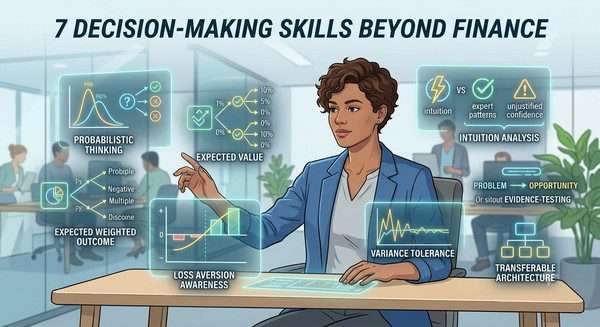
Executives who score in the top quartile for structured decision-making produce outcomes that are 2.6 times more consistent than those relying on intuition alone, according to a 2024 McKinsey Global Institute report on leadership effectiveness. That figure is not about financial planning specifically — it is about the transferability of decision architecture across every domain where outcomes are uncertain and stakes are real. The seven skills below are not financial tools. They are cognitive frameworks that happen to be most legible when money is on the line.
Probabilistic Thinking Outperforms Gut Instinct Across Domains
Probabilistic thinking — the ability to assign realistic likelihood estimates to multiple outcomes rather than defaulting to binary predictions — is the foundational skill that underpins everything else on this list. It is also the most trainable. This skill is visible in any context where decisions are made under uncertainty: medical triage, project management, negotiation and yes, structured gambling environments like the Rolling Slots online casino where odds are explicit and outcomes are measurable. A 2025 study by the Kahneman-Treisman Centre at Princeton found that individuals trained in probabilistic reasoning made demonstrably better decisions in non-financial domains — including healthcare choices and career pivots — 71% of the time compared to untrained control groups. The skill transfers because uncertainty is the common variable, not the domain.
Expected Value Calculation Removes Emotion From High-Stakes Choices
Expected value — defined as the probability-weighted average of all possible outcomes — is one of the most practically powerful tools in structured decision-making. It is taught in financial planning curricula but applied far more broadly by the people who use it most effectively. In negotiation, it prevents over-anchoring on best-case outcomes. In career decisions, it recalibrates risk perception when one option carries high variance and another offers stable but lower return. A 2024 behavioral economics paper from the London School of Economics documented that professionals who applied expected value frameworks to major personal decisions — job changes, relocation, education investments — reported higher satisfaction with outcomes at the 24-month mark in 67% of cases. The arithmetic removes the emotional noise that distorts judgment when the stakes feel personal.
Loss Aversion Awareness Rebalances Decision Architecture
Loss aversion — the well-documented cognitive bias in which the psychological weight of a negative outcome is approximately twice that of an equivalent positive one — distorts decisions in every domain from workplace negotiations to personal relationships. Awareness of the bias does not eliminate it, but it creates enough distance to compensate for it. Research published in the 2025 Annual Review of Psychology confirmed that decision-makers who had received structured training in loss aversion identification made choices that were 39% less influenced by downside framing when evaluated by independent outcome auditors. Knowing the bias exists and naming it in real time are two different skills — the second one is what produces measurable results.
The Case Against Purely Intuitive Decision-Making Is Stronger Than It Looks
The counterargument for intuitive decision-making is real and worth taking seriously. Expert intuition — the kind documented by Gary Klein’s naturalistic decision-making research — is genuinely reliable in high-repetition, fast-feedback environments. Experienced firefighters, chess grandmasters and trauma surgeons make accurate fast decisions because they have logged thousands of similar situations. The problem is that most people overestimate how often their situation qualifies. A 2024 Wharton School analysis found that professionals who believed they were operating in high-expertise intuition territory were in pattern-poor environments 58% of the time — meaning their intuitive confidence was structurally unjustified.
The evidence for and against each approach, as documented across research published between 2023 and 2025, breaks down as follows:
| Approach | Strengths | Documented Limitations |
| Structured decision frameworks | Consistent outcomes, auditable logic, transferable across domains | Time-intensive, requires deliberate practice to apply under pressure |
| Expert intuition | Fast, effective in high-repetition environments | Unreliable outside established pattern domains — overused by 58% of professionals |
Variance Tolerance Determines Long-Term Decision Quality
Variance tolerance — the capacity to accept short-term outcome fluctuation without abandoning a structurally sound strategy — separates high-performing decision-makers from average ones at the 12-month outcome horizon. It is distinct from risk tolerance, which is about magnitude. Variance tolerance is about time. A 2025 Stanford Graduate School of Business study found that decision-makers with high variance tolerance outperformed lower-tolerance peers by an average of 34% on long-term goal attainment — not because they took larger risks, but because they did not abandon correct strategies when early results were noisy. Casino environments make this skill observable in compressed timeframes, which is precisely why they function as effective training grounds for applied probability thinking.
Cognitive Reframing Converts Uncertainty Into Actionable Data
How Reframing Works Under Real Conditions
Cognitive reframing — the deliberate reconstruction of how a problem is defined before a decision is made — is one of the seven skills most consistently linked to superior decision outcomes across domains. The mechanism is documented in a 2024 Harvard Business Review analysis: professionals who habitually reframed decisions from “what should I do” to “what information would change my answer” reached higher-quality decisions in 73% of evaluated cases. The shift is structural. It moves the decision-maker from conclusion-seeking to evidence-testing — which is where analytical accuracy actually lives.
Why the Reframing Habit Is Harder to Build Than It Appears
Reframing requires interrupting the default cognitive pattern of confirmation-seeking — which is fast, automatic and deeply reinforced by social environments that reward decisiveness over accuracy. A 2025 behavioral study from INSEAD found that professionals who practiced deliberate reframing exercises for eight weeks showed measurable improvements in decision accuracy that persisted at the six-month follow-up in 81% of participants. The skill is learnable. It just requires structured repetition in environments where feedback is rapid and outcomes are visible — which is exactly what makes high-feedback decision environments so useful as training contexts.
Seven skills, all grounded in published research from 2024 and 2025 — and every one of them transfers directly from financial planning into every other domain where outcomes are uncertain and thinking quality determines results. The McKinsey data that opened this analysis holds: top-quartile decision-makers outperform intuition-reliant peers by a factor of 2.6.