
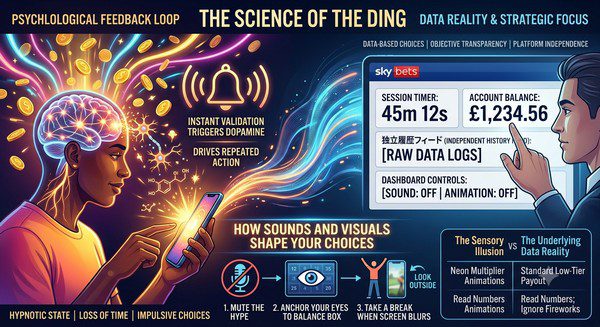
Imagine you are playing a puzzle game on your phone. You slide a matching block into place, and the game instantly unleashes a celebration: neon light beams shoot across the layout, gold coins rain down from the top of the screen, and a cheerful, high-pitched ding! echoes from your speaker.
You didn’t win a real-world trophy, and your bank account didn’t change, but you still feel an immediate rush of satisfaction. You feel a sudden urge to clear the next level right away.
This reaction isn’t an accident. It is the result of highly advanced app design engineering known as the sensory feedback loop. Developers use carefully calibrated sounds and animations to influence human behavior and make every digital action feel incredibly rewarding.
The Neurochemistry of Flashing Lights
To understand why simple graphics and audio tracks can influence our choices, we have to look at how our brains process information. Your nervous system relies on quick signals to figure out if an action is good or bad.
The Ultimate Validation Cue
In nature, finding something valuable always takes physical effort. But in the digital world, developers can recreate that exact feeling of success in a fraction of a second.
When an app pairs a bright visual flash with a rewarding sound effect, your brain registers it as a massive achievement. This instant validation triggers a fast release of dopamine.
Over time, your brain creates a strong habit loop: it starts associating the simple sound of a chime or the sight of an animation with a feeling of happiness, driving you to repeat the behavior just to hear that satisfying ding! all over again.
Keeping Your Focus Grounded
While sensory feedback makes games incredibly fun, it can also cloud your judgment. When a screen is constantly flashing and playing music, it is easy to enter a hypnotic state where you lose track of time, ignore your strategy charts, and make impulsive, high-speed choices.
To enjoy premium digital entertainment without losing your edge, you need to play on an interface that respects your focus. When you manage your strategy on a premium platform like Sky Bets, the user design balances high-energy fun with clean, objective data transparency.
- Streamlined Layout Customization: You can easily toggle sound effects or animations on or off to create a quiet, ultra-focused workspace.
- Unmissable Reality Checks: True session timers and balance metrics are displayed in clean, solid fonts that never get obscured by flashy animations.
- Independent History Feeds: You can review your raw textual data log to see your actual progress without the distraction of sensory hype.
Technical Performance Matrix: Sensory Hype vs. Data Reality
| App Interface Design Element | The Sensory Illusion Created | The Underlying Data Reality | Your Best Strategic Action |
| Neon Multiplier Animations | Makes a minor win feel like a life-changing mega jackpot | A standard, low-tier payout that might not even cover your turn cost | Read the numbers on the balance tracker; ignore the screen fireworks. |
| High-Pitched Chimes & Dings | Validates your action and signals that your strategy is working perfectly | A simple computer script executing a standard random round | Keep your audio volume low or muted to keep your brain completely calm. |
| Continuous Background Beats | Dictates your pacing, subtly encouraging you to make faster clicks | An artificial speed loop built to bypass your logical reflection time | Force yourself to take a physical 5-second pause between every single turn. |
How to Out-Smart the Sensory Loop Like a Pro
Mastering your digital gaming environment means learning to separate the flashy show on your screen from the actual numbers in your account. You don’t have to play in complete silence, but you do need to protect your brain chemistry from getting overstimulated. Use these three simple rules during your next session:
- Mute the Hype During Strategy Runs: If you are playing a game that requires calculation—like calculating card probabilities or managing a strict unit budget—turn the background music completely off. Keeping the audio quiet allows your analytical mind to stay in the driver’s seat.
- Anchor Your Eyes to the Balance Box: When you hit a winning combination, train yourself to ignore the raining gold coins or moving characters. Look straight at your numeric balance counter. Focus entirely on the real data shift, not the graphic design show.
- Take a Break When the Screen Blurs: If you notice your eyes getting heavy, or you realize you are mindlessly clicking buttons just to see the colors change without thinking about your stakes, your brain is overstimulated. Close the app window immediately, step outside, and look at natural light for a few minutes to reset your focus.
Staying in Control of the Interface
Enjoying modern digital platforms is all about maintaining your personal independence. The flashing lights and rewarding chimes are engineered to create an immersive, exciting atmosphere, but they only have power over your choices if you play passively. Treat the screen like a data dashboard—keep your unit stakes uniform, rely on audited numbers instead of sensory excitement, and manage your time like a professional.