
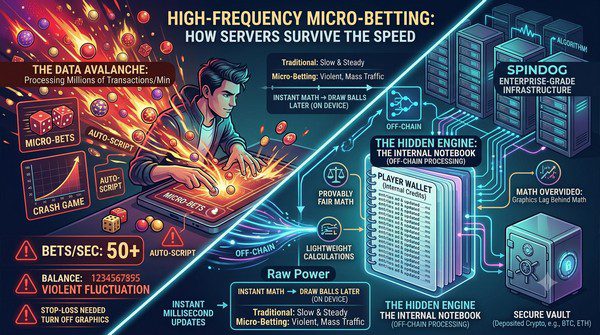
When a participant watches a Plinko board raining down dozens of balls at once, or sets a Dice game to automatically roll fifty times a second, it looks like simple digital magic. The numbers flash, the bankroll updates instantly, and the game never skips a beat. However, underneath those smooth animations is an absolute logistical nightmare. Processing real money transactions at lightning speed requires a level of computer engineering that rivals Wall Street trading firms. To understand how the casino survives this relentless barrage of rapid-fire wagers, one must look past the flashy graphics and examine the raw power of the casino’s internal database.
The Hidden Engine: Managing the Data Avalanche
A standard video slot requires a player to click a button, wait three seconds for an animation to finish, and then click again. The server has plenty of time to breathe, calculate the math, and update the balance before the next wager arrives. High-speed instant games completely destroy this relaxed timeline.
When a participant fires up an automated betting script on a premium platform like SpinDog, they might be placing up to twenty micro-wagers every single second. Multiply that by thousands of players globally doing the exact same thing, and the casino is suddenly forced to process millions of individual financial transactions per minute. It is a relentless data avalanche that would instantly crash a traditional, poorly optimized website.
To handle this, modern digital casinos completely separate the heavy visual graphics from the lightweight math. When a player rapidly drops 100 Plinko balls, the server does not actually calculate the physical bouncing animation 100 times. It instantly runs the Provably Fair math 100 times in a fraction of a millisecond, updates the player’s wallet balance, and then simply tells the player’s local computer or phone to “draw the bouncy balls” to make it look pretty. The heavy lifting is done by the math engine, not the video card.
The Secret of the Internal Notebook
The biggest question participants have is how the casino avoids paying massive blockchain network fees for all these tiny, split-second bets. If every single 10-cent dice roll was processed directly on the Bitcoin or Ethereum network, the game would take ten minutes to play and cost $20 in gas fees per click.
The solution is “Off-Chain Processing.” Once a participant deposits their crypto into the casino, the digital coins are placed in a secure vault. The casino then gives the player internal digital credits to play with. This acts exactly like a lightning-fast internal notebook. When the participant is rapidly micro-betting, the casino is simply erasing and rewriting the numbers in this private notebook thousands of times a second. The actual, slow blockchain is never touched again until the player finally hits the “Withdraw” button to take their winnings home.
Easy Comparison: Slow Betting vs. Micro-Betting
To highlight just how aggressively the server architecture has to work to support instant arcade games, review this easy comparison table.
| Betting Environment | Traditional Table Games (Blackjack/Roulette) | High-Frequency Instant Games (Dice/Plinko) |
| Speed of Wagers | 1 to 5 bets per minute. | Up to 50 bets per second. |
| Server Load | Very light. Plenty of time to process data. | Massive. Requires enterprise-grade server infrastructure. |
| Visual Processing | Handled mostly by the casino’s live video feed. | Handled locally by the player’s own device (phone/computer). |
| Bankroll Fluctuation | Slow and steady. Easy to track visually. | Violent. The balance moves faster than the human eye can read. |
Smart Tips for High-Speed Betting
Because the server is designed to process wagers faster than the human brain can actually comprehend, participants must take extra precautions when firing up a high-speed session.
- Watch the balance, not the animations: If a participant turns on an ultra-fast automated script, the visual graphics on the screen will actually lag behind the math. The server has already processed the wins and losses, but the screen is still trying to draw the animations. The participant should always look at their total account balance to see their true financial standing, not the game board.
- Turn off the flashy graphics: If a participant is playing on an older smartphone or a weak Wi-Fi connection, dropping 50 Plinko balls at once will cause the device to overheat or freeze. Most premium instant games have a “Fast Mode” or “Disable Animations” toggle in the settings. Turning this on shuts off the graphics and just displays the raw math, allowing the game to run flawlessly.
- Set your stops before you start: High-frequency betting means high-frequency losses. If a strategy goes wrong at 20 bets per second, a healthy bankroll can hit zero before the player even has time to manually move their mouse to the “Stop” button. Participants must absolutely rely on the built-in “Stop-Loss” settings in the auto-bet menu to act as a digital emergency brake.
- Check the internet ping: While the casino processes the math instantly, a bad internet connection can cause commands to get stuck in transit. If a participant has a poor connection, clicking “Cash Out” in a rapid game of Crash might take a full second to reach the server, resulting in a devastating and avoidable loss.
High-frequency micro-betting is an absolute marvel of modern database engineering. By understanding that the casino separates the raw math from the visual fluff—and processes everything off the main blockchain—participants can safely enjoy the adrenaline rush of executing hundreds of wagers in the blink of an eye. Setting strict limits ensures the speed of the server never outpaces the player’s common sense.