
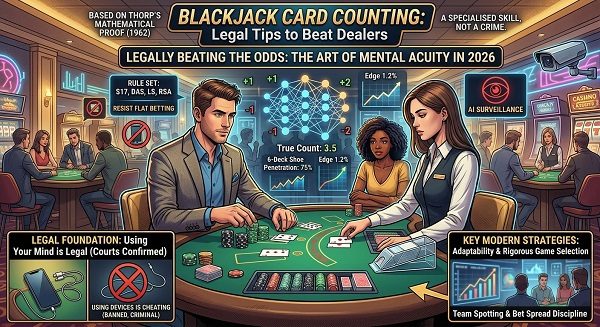
Card counting is not cheating. Never was. Courts confirmed this decades ago, and yet casinos still throw people out for doing it — which is their legal right too. That tension, between a skill that’s perfectly lawful and an industry hell-bent on stamping it out, is what makes blackjack the most intellectually alive game on any casino floor.
Edward Thorp sat down with a computer in 1962 and essentially broke blackjack. His book Beat the Dealer didn’t just offer tips — it proved mathematically, with actual probability analysis, that the game could be beaten. Not by luck. By thinking. That was the first real crack in the house-edge armour, and casinos like Betandplay have been patching it ever since.
What Thorp Actually Proved and Why It Matters Now
Before 1962, blackjack was treated as pure chance. Thorp’s breakthrough reframed it entirely — the composition of the remaining deck directly affects the probability of the next hand. High cards favour the player; low cards favour the dealer. Track the ratio, adjust your bets accordingly. Simple in concept. Brutally difficult in execution under casino conditions.
The original counting systems targeted single-deck games, which barely exist in mainstream casinos anymore. But the mathematical core — shuffle penetration analysis, running count vs. true count conversion, bet-spread management — that core survived every technological countermeasure thrown at it. The house edge in blackjack with basic strategy alone sits around 0.5%. Add a competent counting system and that edge flips, historically reducing the house advantage by a further 0.5 to 1.5 percentage points depending on rules and penetration.
“I spent three years learning Hi-Lo counting and another year learning how to not look like I was counting,” recalls one advantage player from an online forum dedicated to blackjack theory. “Thorp gave us the map. Casinos just kept redrawing the territory.”
Decades of Cat and Mouse Between Counters and Casinos
The 1960s and 1970s were almost the golden age of advantage play. Organized counting teams, some running coordinated big-player and spotter systems, pulled serious money from Vegas floors. Casinos scrambled. The countermeasures that emerged across each decade tell the whole story:
- 1960s–1970s — rule changes to reduce deck penetration and limit re-splits
- 1980s–1990s — multiple-deck shoes became standard, legal rulings confirmed casinos could eject known counters
- 2000s — continuous shuffling machines (CSMs) introduced, electronic facial recognition surveillance deployed
- 2010s onward — AI-assisted detection systems, bet-spread monitoring software, cross-property counter databases
That 1980s legal shift deserves more attention than it usually gets. Courts drew a clean line: using your brain to count cards is a mental skill and is legal. Using a device — a hidden computer, a shoe sensor, anything external — is cheating and is criminal. That distinction still governs the practice in 2026. Casinos cannot arrest you for counting. They can, however, ask you to leave, ban you from the property, or simply flat-bet you into irrelevance by capping your maximum wager.
“The moment they flat-bet me, the whole exercise became pointless,” said one forum member who documented two years of counting sessions. “Legal protection means nothing when they cap your upside at €25 a hand.”
Techniques That Actually Survived Into 2026
Six-deck shoes with 75% penetration are the realistic target environment for any counter operating today. Here’s what matters — not every counting system is equal, and not every casino condition is worth your time. The techniques that survived the transition from the 1970s advantage era to the modern detection-heavy floor are the ones built around adaptability rather than rigid system application.
The table below breaks down the major counting systems still used by advantage players, comparing their difficulty against their realistic edge in a 6-deck shoe environment:
| Counting System | Difficulty Level | Edge in 6-Deck Shoe (approx.) | Real-World Note |
| Hi-Lo | Moderate — the classic starting point | 0.5–1.0% player advantage | Most widely taught, most widely profiled by surveillance |
| Omega II | High — multi-level point values | Up to 1.3% under good penetration | Genuinely better edge but exhausting to maintain under pressure |
| Wong Halves | Very High — fractional card values | Theoretically strongest of the three | Almost nobody sustains this accurately in a live casino environment |
| KO (Knock-Out) | Low-Moderate — unbalanced system, no true count needed | Slightly below Hi-Lo | Better for beginners; sacrifices precision for simplicity. Fair trade, actually. |
What Game Selection Actually Means in Practice
Game selection is probably the most underrated skill in modern advantage play. Not the counting itself — the decision about which table to sit at in the first place. A technically perfect counter at a table with poor penetration (say, 50% on a 6-deck shoe) is essentially burning time. The maths doesn’t work. The count never gets meaningful enough to justify a large bet spread before the shuffle resets everything.
Penetration analysis — figuring out roughly how deep a dealer will go before shuffling — determines whether a session has any realistic edge at all. Counters who survived into the current era obsess over this. They walk floors. They watch dealers before committing. They leave tables mid-shoe if conditions deteriorate. That’s not paranoia. That’s basic operational discipline built from decades of trial and error post-Thorp.
Some platforms like Betandplay offer live dealer blackjack variants that explicitly advertise their shuffling frequency and deck penetration in the game information panel — which, honestly, is more transparency than most physical floors give you. Not all online environments support counting in the traditional sense due to continuous virtual shuffles, but understanding penetration still helps you filter which table formats are worth your attention.
“I stopped playing at tables where I couldn’t see at least 4.5 decks dealt before the shuffle,” noted one experienced counter in a blackjack strategy community thread. “That single filter cut my session volume in half and roughly doubled my hourly expectation.”
Is Card Counting Worth Learning in 2026
Bluntly — it depends entirely on what you’re expecting from it. As a guaranteed income strategy, it’s dead. The 1970s version of advantage play, where a competent counter could reliably grind positive expected value across hundreds of hours, is gone. Continuous shufflers, AI surveillance, cross-property ban lists, and aggressive flat-betting policies have dismantled that model completely.
As a specialised skill that occasionally creates real player advantage under the right conditions — still alive. Barely. The players who make it work in 2026 combine counting with:
- Rigorous game selection based on penetration depth
- Team-based spotting to avoid individual detection patterns
- Bet-spread discipline — never escalating so sharply that surveillance algorithms flag the session
- Constant rule-set research because small variations in doubling, splitting and surrender rules shift the baseline edge significantly
At venues featuring live dealer formats, Betandplay among them, rule transparency has actually improved — some operators now list the exact shoe depth and reshuffling policy in the lobby description. That information alone is worth more to a serious player than any counting shortcut.
Card counting began as a mathematical proof and became a cultural obsession. It’s legal, it’s difficult, and in 2026 it requires more discipline than raw genius to pull off. Thorp’s 1962 breakthrough still holds. The world it unlocked just got considerably more complicated.